InstaSpin Payment Methods for UK Players
 Available in GB
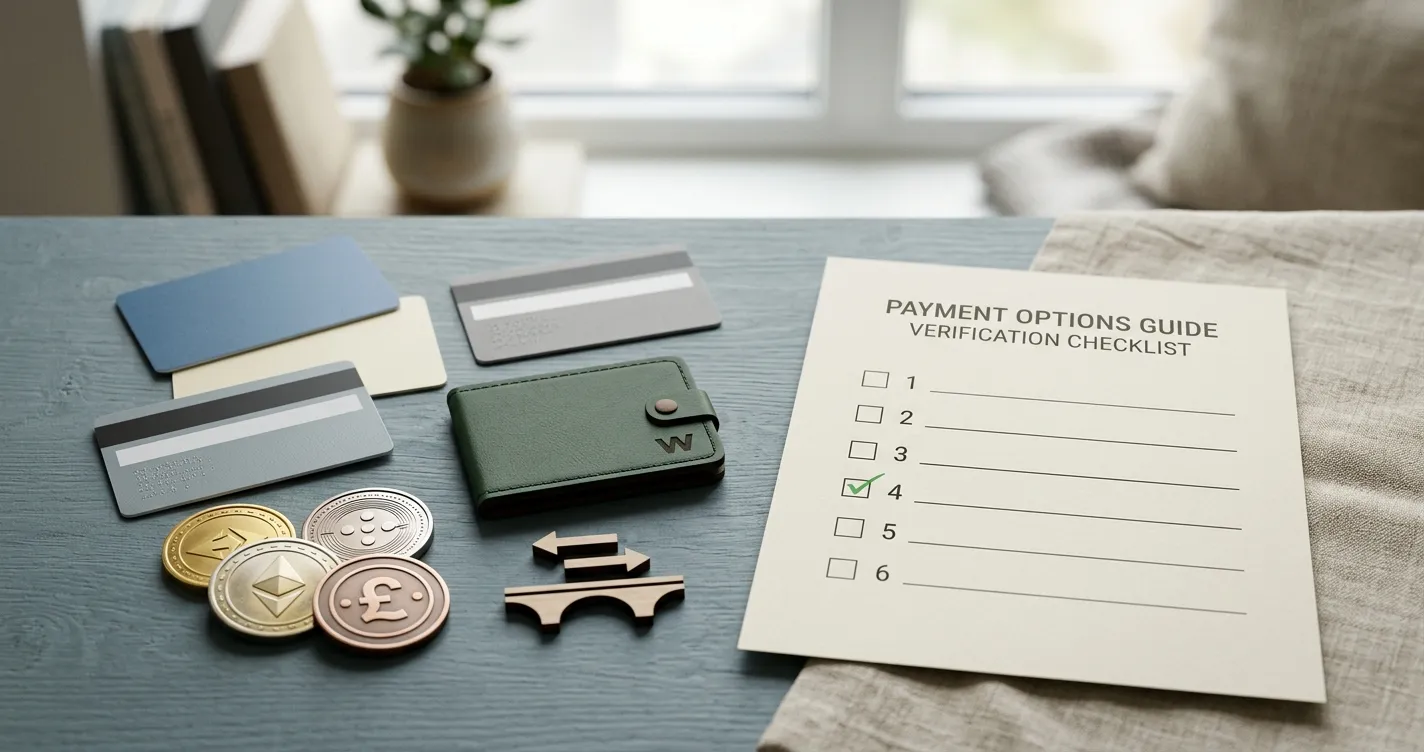
InstaSpin supports fiat and cryptocurrency payments across four broad categories: cards, mobile and e-wallets, bank transfer, and crypto. Independent listings record Visa and Mastercard on the card side, Apple Pay and Google Pay among the mobile wallets, MiFinity and Jeton among the e-wallets, bank transfer as a standalone option, and a crypto set that includes Bitcoin, Litecoin, Ripple or XRP, Tether and Cardano. Some sources also list Ethereum. Find the best options for instaspin .
For a UK reader, the practical limitation is that a reported method list is not the same as guaranteed cashier availability for a UK account. Method visibility, minimum amounts, fees and processing times can vary by account country, currency, verification status and provider availability. The detailed steps sit on the deposit options and withdrawal guide pages; this page covers the brand-level payments picture.
- InstaSpin payment categories at a glance
- Deposits and withdrawals do not behave the same way
- GBP relevance and currency display
- Why identity verification affects payments
- Currency handling and record discipline
- Payment risk checklist
- How payments split into deposit and withdrawal flows
- Payment checks with the biggest impact
- Where the payment route meets the licence question
- Matching a method to a specific UK account
- InstaSpin payments summary for UK players
InstaSpin payment categories at a glance
The reliable read on InstaSpin payments is at the category level. Listings consistently confirm the four broad routes; specific brand availability inside each category is more variable. A payment logo can appear in a general casino profile while the live cashier on a UK-registered account still shows a different mix, depending on provider rules and the operator’s current routing.
| Category | Reported examples | Practical UK-player check |
|---|---|---|
| Cards | Visa and Mastercard are listed in third-party method reporting. | UK card issuers commonly block gambling transactions or apply cash-advance rules; check your issuer before depositing. |
| Mobile wallets | Apple Pay and Google Pay appear in reported method lists. | Confirm whether the route is deposit-only or also usable for withdrawals from your account. |
| E-wallets | MiFinity and Jeton are reported among the available options. | Check account verification, supported currency at the wallet, and any per-route minimums. |
| Bank transfer | Bank transfer is listed as a standard category. | UK bank-side gambling blocks and SCA flows can introduce friction; allow extra time on the first transaction. |
| Cryptocurrency | Bitcoin, Tether and other major coins are reported. | Confirm network and coin selection, address accuracy, and the exchange-rate risk between deposit and withdrawal. |
Deposits and withdrawals do not behave the same way
A fast deposit route is not automatically the best withdrawal route. Cards often allow quick deposits but can be slower or limited on the payout side, depending on issuer policy. E-wallets usually offer matched two-way flows but only after verification. Bank transfer carries the most predictable identity trail but the longest processing window. Crypto can move quickly on both sides but adds wallet-ownership and network-selection questions that fiat methods do not.
Before committing a payment method, three checks resolve most surprises: whether the route is visible in the live cashier on your account, whether the same route is available for withdrawals, and whether the route affects bonus eligibility. The promotions guide covers the bonus side; some welcome offers exclude specific routes from qualification, which is worth knowing before any deposit linked to a promotion.
GBP relevance and currency display
The project currency for this guide is GBP, but the public reporting around InstaSpin payments mixes sources that use other base currencies and crypto. Static review pages should not convert minimum deposit figures, bonus amounts or withdrawal limits into pounds unless the cashier itself shows GBP. Currency conversion changes the effective cost of a deposit, and crypto transactions add network charges and exchange-rate variance on top of any internal cashier figure.
The safest currency check is the live cashier after account setup, before funds move. The cashier should show: the currency the account is denominated in, the minimum deposit at that currency, any maximum deposit, the same details for withdrawals, and any fee or processing window the operator chooses to display. If the cashier shows a non-GBP base currency for your UK account, that is itself a payment decision, not a detail to overlook.
Why identity verification affects payments
Identity verification can affect withdrawals even when deposits process without issue. Casinos commonly verify identity, age, payment ownership or source-of-funds information before releasing funds, particularly when a withdrawal is requested for the first time, when amounts cross internal thresholds, or when account activity changes shape. Public sources for this guide do not document a stable, official KYC document list or processing window for InstaSpin, so this page leaves the specifics to the KYC guide and the live account instructions.
The practical implication is to deposit with a method in your own name, keep payment records during the account’s first weeks, avoid using a card or wallet that belongs to another person, and expect at least one verification check before the first cashout completes. The broader account guide covers consistency between profile details and payment ownership.
Currency handling and record discipline
Currency handling deserves separate attention for UK readers because public bonus and payment values may be displayed in a source currency rather than in GBP. A converted figure from a third-party review can be wrong if InstaSpin shows a different currency in the account, applies account-specific settings, or has changed the promotion since the listing was written. The cashier figure is the authoritative one.
Records matter in parallel. Keeping screenshots or confirmations of deposits, withdrawals, promotion opt-ins and support messages makes it easier to reconstruct what happened if a transaction is delayed. The records should hold dates, amounts, method names and transaction references rather than unnecessary personal data. This is useful in routine operation, not just when something goes wrong, because it makes account review faster.
Payment risk checklist
Checks before depositing
- Confirm the method is visible in your own InstaSpin cashier on the day you deposit.
- Confirm the currency shown to your account and avoid relying on converted figures.
- Confirm the same method can also receive withdrawals.
- Confirm whether the method affects bonus eligibility before linking it to a promotion.
- Confirm whether your bank, card issuer or wallet currently allows gambling transactions.
- Keep transaction records until the first withdrawal has completed.
The largest risk on the payments side is overconfidence in a published list. A category overview is useful for orientation; the account-level cashier is the authority on what is actually available. If a particular method is critical to your decision to play, verify it on a small deposit before building a balance.
How payments split into deposit and withdrawal flows
At a category level, InstaSpin treats deposits and withdrawals as separate flows even within the same payment family. Card deposits often clear instantly, while card payouts can require additional issuer co-operation. E-wallets typically support matched two-way movement once the wallet account is verified. Bank transfer remains the slowest route in both directions, but produces the cleanest paper trail for support disputes. Crypto behaves quickly on both sides, with network selection and address accuracy carrying the operational risk that fiat methods do not.
The detailed cashout workflow — verification triggers, bonus wagering impact, method matching, what affects payout speed in practice — sits on the cashout checks page. The first-transaction flow and the interaction with welcome-package opt-ins sit on the funding methods page.
Payment checks with the biggest impact
The highest-impact payment checks are method ownership, withdrawal availability, currency display and verification readiness. Method ownership confirms that the payment source belongs to the account holder, which removes the most common cashout dispute. Withdrawal availability confirms that the route can move money out, not only in. Currency display prevents mistaken assumptions about GBP values. Verification readiness reduces the chance that a payout becomes the first time the account is examined in detail.
A player who resolves those four points before depositing has a clearer view of the operator than a player who only compares logos. Logos show possibility; account-specific cashier behaviour and withdrawal rules show practical usability.
Where the payment route meets the licence question
The payments picture cannot be read in isolation from the licence position. No UKGC licence was returned for InstaSpin in the public-register search, so dispute access for payment issues runs through the operator’s own complaints procedure rather than through a UK alternative-dispute scheme. A UKGC-licensed operator carries an ADR route by default; an offshore-licensed operator does not. That is not unique to InstaSpin — it applies to the offshore market in general — but it is relevant to how a UK player should weight the cashier convenience against the dispute path.
The safety review page covers the licence-and-protection picture, and the verification checks page covers the identity side that interacts with both payments and complaints. Read them in that order rather than after a withdrawal problem has already appeared.
Matching a method to a specific UK account
A method that is visible in the cashier may still be a weak fit for a specific UK player. The decisive details are ownership of the route, whether the same route can run in both directions of money flow, whether the cashier currency matches the player’s bank or wallet, and whether the player can produce a clean transaction record if support asks for evidence later. None of those is a barrier to play; together, they decide whether the payment side stays out of the way during normal use.
A UK player who already uses MiFinity or Jeton, holds a current GBP card with a gambling-friendly issuer, or runs a Bitcoin or Tether wallet they control will find the InstaSpin cashier easier to navigate than a player without those routes in place. The mismatch cases — borrowed cards, third-party wallets, exchange addresses controlled by someone else — are the ones that turn ordinary withdrawals into prolonged support tickets. Read our detailed review of InstaSpin Deposits for UK Players .
InstaSpin payments summary for UK players
InstaSpin is reported to support fiat and crypto payments, with cards, mobile wallets, e-wallets, bank transfer and cryptocurrency appearing across the verified payment-category sources. Treat those categories as a starting map, not a promise that every method is available to every UK account. Before depositing, confirm the live cashier method, the GBP or alternative-currency display, the withdrawal direction of the same route, bonus eligibility implications and verification expectations.
For the brand-level context, return to the InstaSpin UK review. For the safety and licence picture, read the safety review before moving to a first deposit.
Published by the Instaspin team.